
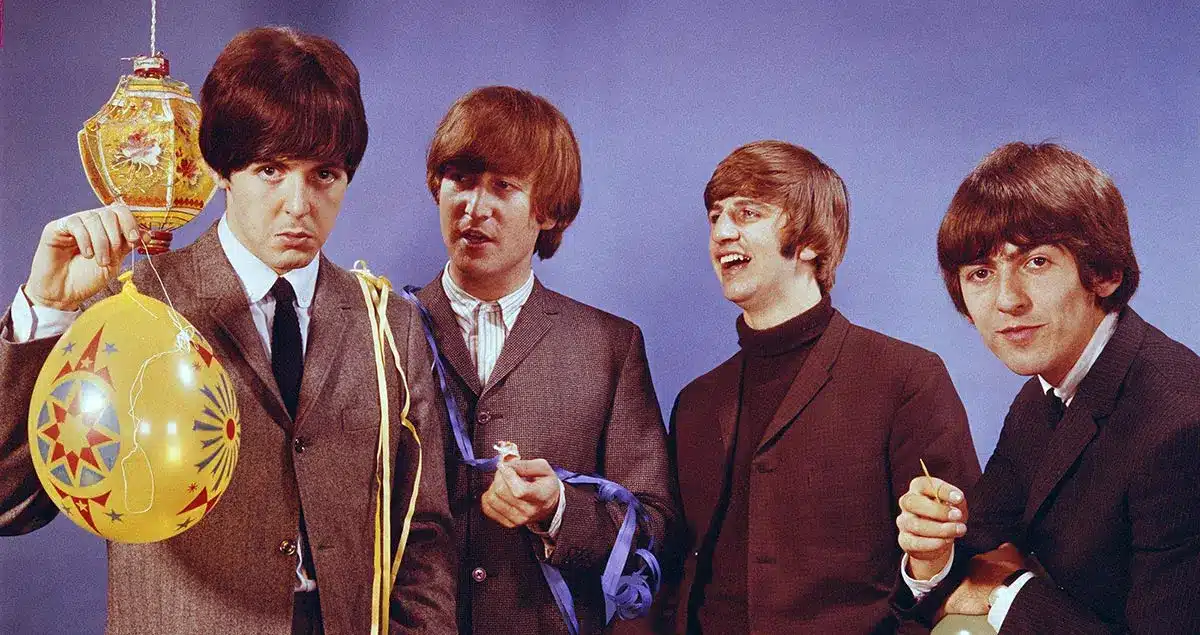
The Beatles: Songwriting, Studio Innovation, and the Redefinition of Popular Music
Quick Facts
Founded: 1960
Origin: Liverpool, England
Genres: Rock, Pop Rock, Psychedelic Rock
Classic Line-Up: John Lennon, Paul McCartney, George Harrison, Ringo Starr
Years Active: 1960–1970
Origin Story – Liverpool and Hamburg
The Beatles began as a skiffle-influenced group formed by John Lennon in the late 1950s. Paul McCartney joined soon after, followed by George Harrison. The early years were unstable, with frequent lineup changes and limited commercial success.
Their development accelerated in Hamburg, Germany. Performing long sets nightly in clubs forced the band to tighten their musicianship and expand their repertoire. By the time Ringo Starr joined in 1962, the group had developed both endurance and cohesion.
Manager Brian Epstein reshaped their public image. Producer George Martin refined their sound in the studio. Together, this management structure created a disciplined but flexible creative environment.
The Beatles were not immediately revolutionary. Their evolution was gradual but consistent.
The Turning Point – Beatlemania and Original Songwriting
By 1963, The Beatles were leading the British music scene. Songs like “She Loves You” and “I Want to Hold Your Hand” established them as dominant pop figures.
However, their real shift occurred when Lennon and McCartney committed fully to original songwriting. Instead of relying on cover material, they built a catalog of structurally efficient, melody-driven songs.
The American breakthrough in 1964 expanded their influence globally. Beatlemania was not just commercial success; it was cultural saturation.
But popularity was only one part of their trajectory.
The Studio Transformation – Beyond Touring
By 1966, The Beatles stopped touring. The decision was practical: live performance technology could not replicate their increasingly complex recordings.
Freed from touring constraints, they began treating the studio as an instrument.
Albums like Revolver (1966) introduced tape loops, reversed audio, and non-Western instrumentation. George Harrison incorporated Indian influences. Lennon explored abstract lyricism. McCartney expanded harmonic structure.
This period marked the transition from pop band to studio innovators.
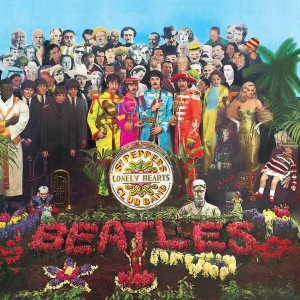
Milestone Album – Sgt. Pepper’s Lonely Hearts Club Band (1967)
Sgt. Pepper’s Lonely Hearts Club Band is widely considered their most influential album.
Rather than a simple collection of songs, it presented a loosely unified concept. The production featured orchestration, layered recording techniques, and controlled sequencing.
Key structural elements included:
-
Seamless transitions between tracks
-
Orchestral crescendos
-
Multi-track experimentation
-
Varied instrumentation
The album reframed expectations for popular music. It suggested that a rock album could function as a cohesive artistic statement.
Its influence extended beyond genre boundaries into visual art, fashion, and counterculture identity.
Signature Song – A Day in the Life
“A Day in the Life,” the closing track of Sgt. Pepper, encapsulates The Beatles’ studio-era ambition.
The song merges two separate compositions — one primarily by Lennon, the other by McCartney. It incorporates an orchestral crescendo that builds from near silence to controlled chaos before resolving into a sustained piano chord.
The final chord, held for over 40 seconds, demonstrates their willingness to challenge structural norms.
Rather than relying on repetition or chorus-based hooks, the track prioritizes progression and atmosphere.
It remains one of the most analyzed recordings in rock history.
Internal Dynamics and Fragmentation
The creative partnership between Lennon and McCartney was central to The Beatles’ success, but it also generated tension. As individual artistic identities grew stronger, cohesion weakened.
George Harrison emerged as a significant songwriter during the later years. Ringo Starr’s drumming, often understated, provided rhythmic stability across stylistic changes.
By the time of The White Album (1968), the band functioned more as four independent writers sharing a project.
Business disputes and personal differences escalated during the recording of Let It Be. In 1970, Paul McCartney publicly announced his departure.
The band dissolved, but their catalog remained intact.
Members
John Lennon – Vocals, Guitar
Paul McCartney – Bass, Vocals
George Harrison – Guitar
Ringo Starr – Drums
George Martin served as producer throughout most of their career and played a key role in shaping their studio sound.
Selected Studio Discography Highlights
Please Please Me (1963)
A Hard Day’s Night (1964)
Rubber Soul (1965)
Revolver (1966)
Sgt. Pepper’s Lonely Hearts Club Band (1967)
The Beatles (White Album) (1968)
Abbey Road (1969)
Let It Be (1970)
Structural Contribution to Music
The Beatles influenced modern music in measurable ways:
-
Album-Oriented Listening
They elevated the album from a collection of singles to a structured artistic format. -
Studio Experimentation
Multi-track recording, tape manipulation, and orchestral integration became mainstream tools. -
Songwriting Efficiency
Lennon-McCartney compositions balanced melodic accessibility with structural creativity. -
Global Pop Standardization
Their model of band structure — vocalist, guitarist, bassist, drummer — became the default format for rock bands.
Unlike bands defined by heaviness or rebellion, The Beatles’ impact centered on composition and production.
Legacy
The Beatles’ influence extends across genres — rock, pop, alternative, experimental, and beyond.
Their career lasted only a decade, yet their catalog continues to define songwriting benchmarks. Many later innovations in rock music trace back to ideas first explored in their mid-to-late 1960s recordings.
They did not simply dominate their era.
They redefined its possibilities.